ABA therapy for nonverbal children with autism: communication skills at home
In-home ABA teaches your child a way to ask, refuse and share, whether that is words, signs, pictures or a talking device, starting with the things they want most.
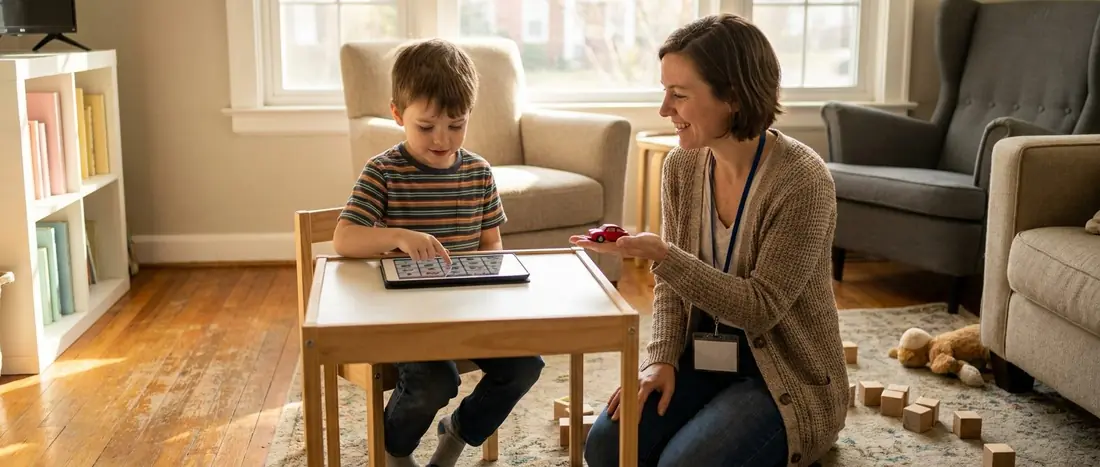
ABA therapy can help a nonverbal child communicate. In-Home ABA Richmond starts with functional communication: one clear way for your child to ask for what they want, whether that's a word, a sign, a picture or a tap on a device.
- The first goal is communication, not perfect speech. Talking often grows from there.
- At home, the "teaching moments" are real: snacks, toys, the TV, going outside.
- Signs, picture cards and AAC devices don't stop speech. They give your child a voice now.
- ABA works alongside speech therapy, and the two should share goals.
How applied behavior analysis builds communication: function first
Functional communication means using a message to get something done: "more", "help", "stop", "go outside". It matters more than the number of words a child can name on flashcards.
When a child has no way to ask, frustration builds. Many meltdowns are messages. Teaching a simple way to say "I want" or "all done" can calm a whole household.
“Parents are taught strategies for capturing their children’s attention and promoting communication. By using these strategies throughout the day, the children were offered many opportunities to learn to interact with others.”
Nonverbal communication and other ways a child with autism can communicate
| Method | What it is | Good for |
|---|---|---|
| Spoken words | Sounds, word parts, then words and short phrases | Children who babble or copy sounds |
| Sign language | Simple signs like "more", "eat", "help" | Children who copy actions well |
| Picture exchange | Handing over a picture card to ask for something | Children who need a clear, visible message |
| AAC device | A tablet or device that speaks when a picture is tapped | Children with many things to say and few spoken words |
Many children use more than one. A BCBA, a speech-language pathologist and you decide together, based on your child's unique needs. Alternative communication is a normal part of ABA programs for autistic children.
Benefits of ABA therapy at home for communication and social skills
At home, the things your child wants are right there: the snack cupboard, the favourite toy shelf, the back door. Every one is a chance to practise. The therapist can set up dozens of real reasons to communicate in one session.
Parents and caregivers and siblings learn to respond to the new way of asking, which matters as much as the therapy sessions themselves. It also builds social interaction, because every request is a moment with another person. It works all day, not only during therapy. That's a big reason families pick in-home ABA in Richmond.
ABA therapy techniques: how we teach a child to ask
- Find what your child wants. The therapist watches what your child reaches for and loves.
- Create a reason. The toy is in sight but out of reach, or the snack comes in small pieces.
- Prompt the message. The therapist shows the word, sign or picture and helps your child use it.
- Give it right away. The message works instantly. Your child learns that communicating gets results.
- Fade the help. Over time the therapist gives less help until your child asks alone.
- Build up. One word becomes two: "more juice", then "I want juice".
Communication and challenging behavior
When ABA looks at why a behavior happens, the answer is often communication. A child who hits to escape a hard task can learn to say "break". A child who screams for attention can learn to tap your arm or say your name. This is called functional communication training.
Read more on our page about tantrums and aggression.
ABA therapy and speech therapy
We don't provide speech therapy. Speech-language pathologists (SLPs) are experts in speech sounds, language and feeding. ABA is about learning and behavior, including how a child uses language every day.
The two work well together. With your permission we share goals with your child's SLP, so your child hears the same words and uses the same device settings in both. In Richmond, many children see an SLP through Infant & Toddler Connection, their school or a private clinic.
Questions about ABA for nonverbal children with autism
Can ABA therapy help a nonverbal child talk?
Many nonverbal children gain words with ABA and speech therapy, but no one can promise speech. What ABA can promise is a focus on communication, so your child has a reliable way to be understood.
Will a device or picture cards stop my child from talking?
The research so far says no. A 2006 review of AAC studies found that none of the 27 most carefully studied cases lost speech after AAC was introduced, and 89% gained some speech, though the gains were modest and the studies were small (Millar, Light and Schlosser, 2006). A device gives your child a voice now and takes pressure off.
What's the difference between ABA and speech therapy?
An SLP treats speech and language skills. ABA teaches through reinforcement and practice, and covers communication along with behavior, play and daily living. Many children do both.
My child is 4 and not talking. Is it too late?
No. Children keep learning to communicate at every age. Start now with whatever method works, and keep building.