What in-home ABA therapy looks like: a session at home, hour by hour
An in-home ABA session is a planned stretch of play and practice at your house, led by a behavior technician and guided by a BCBA, with you learning alongside.
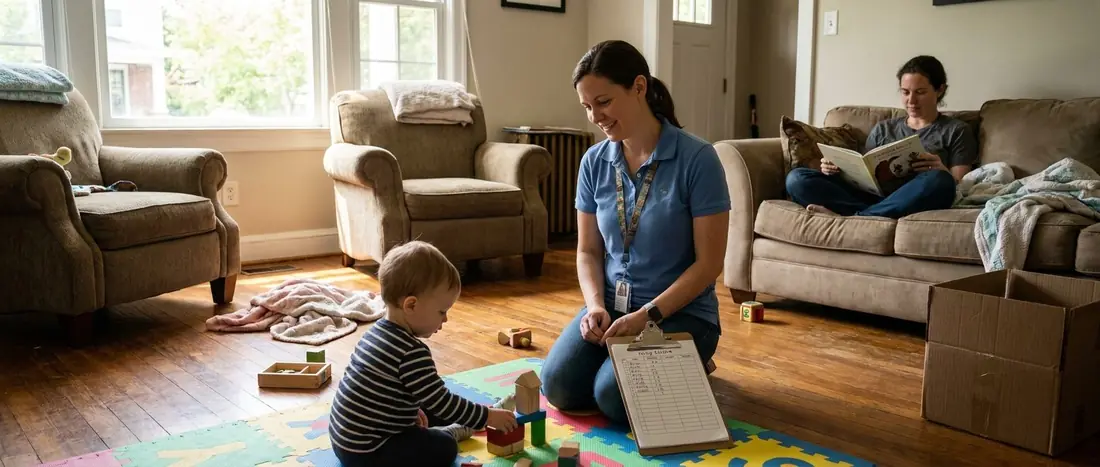
A typical in-home ABA therapy session runs two to four hours. A Registered Behavior Technician (RBT) works one-on-one with your child on goals the BCBA picked, mostly through play and daily routines. The BCBA visits regularly to check the data, adjust the plan and coach you.
- Who comes: an RBT for most sessions, a BCBA for supervision and parent coaching.
- What they do: short teaching moments inside play, snacks, toileting, dressing and transitions.
- What you need: a parent or caregiver at home, a little floor space and the TV off.
- How progress shows: the team writes down data every session and reviews it with you.
Who comes to your house: the ABA therapist and the BCBA
In-home ABA therapy is applied behavior analysis delivered where your child lives. Two kinds of professionals share the work, and you'll get to know both.
| Role | What they do | How often you see them |
|---|---|---|
| BCBA (Board Certified Behavior Analyst) | Assesses your child, writes the treatment plan, trains the technician, reviews data, coaches you | Every week or two, sometimes during a session |
| RBT (Registered Behavior Technician) | Runs the one-on-one therapy sessions and records data | Every session |
| You | Share what matters, practise the strategies between sessions | Every day |
In Virginia, a behavior analyst must hold a state license as well as the BCBA. An RBT is certified by the Behavior Analyst Certification Board and must be supervised by a qualified analyst.
“RBTs assist in delivering behavior-analytic services and practice under the direction and close supervision of an RBT Supervisor and/or RBT Requirements Coordinator who is responsible for their work.”
An in-home ABA session, hour by hour
Every child's therapy plan is different, but most ABA therapy sessions follow a rhythm. Here's an example of a three-hour afternoon session with a four-year-old.
| Time | What happens | What it teaches |
|---|---|---|
| 0:00 to 0:15 | Hello, a quick check-in with you, then free play to warm up | Greetings, trust, choosing a toy |
| 0:15 to 1:00 | Play-based teaching on the floor: blocks, puzzles, pretend kitchen | Asking for things, naming, copying actions, taking turns |
| 1:00 to 1:20 | Snack at the kitchen table | Requesting, waiting, trying a new food |
| 1:20 to 1:40 | Bathroom trip and handwashing | Potty routine, following a picture schedule |
| 1:40 to 2:30 | Short table activities mixed with movement breaks, outside if the weather is good | Following directions, matching, sitting for a short task |
| 2:30 to 2:50 | Clean-up song and a planned transition to the next part of the day | Ending a fun activity without a meltdown |
| 2:50 to 3:00 | A two-minute update for you: what went well, what to practise | Carrying skills into the rest of the week |
Younger children get more play and shorter tasks. Older children may practise homework routines, conversation or getting ready for school.
A sample week of ABA therapy at home
Insurance approves a number of hours per week after the BCBA's assessment. Here's how 15 hours a week could look for a child in preschool. This is an example, not a promise: your child's hours come from the plan your BCBA writes and your insurance approves.
| Day | Session | Who |
|---|---|---|
| Monday | 3:00 to 6:00 pm | RBT |
| Tuesday | 3:00 to 6:00 pm | RBT, BCBA joins for the last hour |
| Wednesday | 3:00 to 6:00 pm | RBT |
| Thursday | 3:00 to 6:00 pm | RBT |
| Friday | 3:00 to 6:00 pm | RBT |
| Every other week | One hour of parent training | BCBA and you |
Some families prefer mornings before preschool or longer sessions on fewer days. Tell us what your week looks like and we will build around it.
How ABA therapy works at home: natural environment teaching and other ABA techniques
ABA uses a few teaching styles. In your home, a trained ABA therapist mixes them through the session to help children learn new skills.
- Natural environment teaching (NET). Teaching inside real moments, like asking for juice at snack time or putting on shoes before the park.
- Discrete trial training (DTT). Short, clear practice rounds, often at a small table, with a reward after each right answer.
- Play-based teaching. The therapist follows your child's interests and builds language and turn-taking into the game.
- Positive reinforcement. Praise, a favourite toy or a fun activity right after a skill, so the skill happens again.
Everyday household items work well: cups, spoons, socks, the laundry basket. The point is that skills learned with your things carry over to your day.
What parents and caregivers do during ABA sessions
A parent or another adult caregiver must be at home during every session. You don't need to sit and watch for three hours. Most parents cook, work or care for siblings nearby, and join when the therapist calls them in to practise.
Siblings are welcome. A brother or sister can be a great play partner for sharing and turn-taking. If a toddler sibling keeps grabbing the toys, the therapist will plan around it, maybe with a second set or a short session in another room.
The therapy space you need in your home environment
You don't need a big house or a special therapy area. A clear patch of floor, a small table or the kitchen table, and somewhere to keep the therapy toys is plenty. Our guide to preparing your home for ABA has a simple checklist.
How progress is tracked in home-based ABA
Your technician writes down data during each session: how often your child used a word, how many steps of handwashing they did alone, how long a meltdown lasted. The BCBA turns that into graphs and checks them every week.
You should see the graphs. Ask to look at them every month. If a goal isn't moving, the plan should change.
Benefits of in-home ABA therapy
Every child with autism is different, but families choose home-based ABA therapy for a few common reasons.
- Skills at home stick. A child who learns to ask for help at your table uses that skill at your table. Learning in the real home setting makes therapy more effective for many children.
- Real-life situations. Bath time, sibling squabbles and getting out the door are all practice, not interruptions.
- Parents learn as they go. You see the ABA strategies every week, so you can help your child between sessions.
- Social skills with the people who matter. Brothers, sisters, cousins and neighbors can join in.
- No commute. Your child starts therapy calm, not after a long drive.
Children with autism spectrum disorder often also see a speech therapist or an occupational therapist. Your therapy team can share goals, so your child hears the same words and steps from everyone.
The first month of in-home ABA
- Week 1: getting to know each other. Lots of play, little pressure. Your child learns the therapist means fun.
- Week 2: the technician starts the first goals and the BCBA watches a session.
- Week 3: first parent training. You practise one strategy, like offering choices.
- Week 4: first data review. You and the BCBA look at what's working and what to change.
Ready to see how it starts? Read how to get started, or learn about in-home ABA therapy in Richmond.
Questions about in-home ABA sessions
How long is an in-home ABA session?
Most in-home sessions last two to four hours. Toddlers often start with shorter sessions. The BCBA sets the length based on your child's age, attention and goals.
Does in-home ABA include parent training?
Yes. Parent training is part of every in-home plan we write. The BCBA meets with you regularly to teach the strategies your child is learning. See parent training.
Can siblings join sessions?
Often, yes. Siblings can help with play and sharing goals. The therapist will tell you when a sibling helps and when your child needs quiet one-on-one time.
How is in-home ABA different from clinic-based ABA?
The teaching is similar, but the setting changes what your child practises. At home the goals use your real routines. In a clinic your child gets more peers and set-up rooms. Read in-home vs center-based ABA.
What if my child cries or refuses?
Therapists expect it at first. They slow down, follow your child's lead and build trust with play. Modern ABA should never use punishment, and you can stop a session at any time.