ABA parent training at home: how parent training in ABA therapy supports your routine
Parent training is where a BCBA teaches you the same strategies your child's therapist uses, so progress keeps going after the session ends.
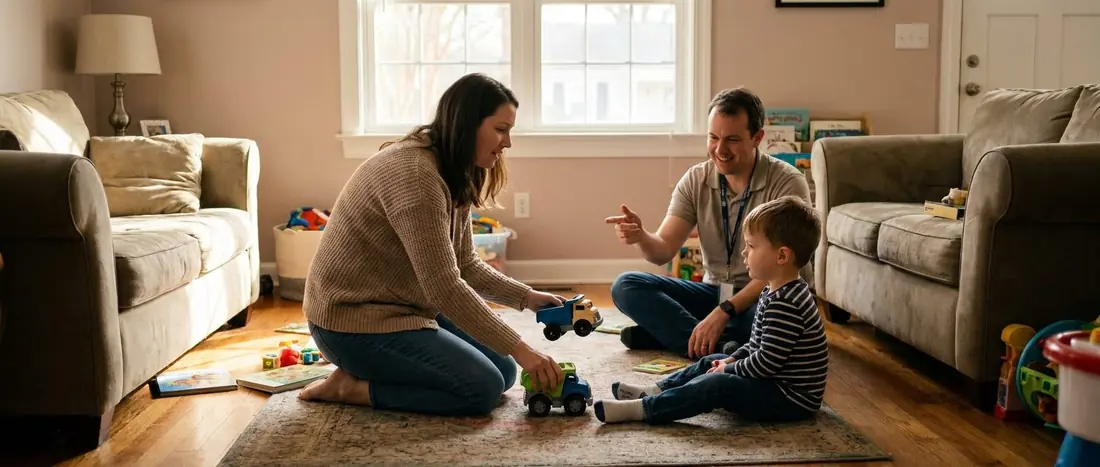
ABA parent training is regular coaching from your child's BCBA. In-Home ABA Richmond builds it into every in-home plan, because you spend far more hours with your child than any therapist does.
- Who: your child's BCBA, with you and any other caregivers who want to join.
- Where: at home, in the routines that are hardest, like bedtime or getting out the door.
- How: the BCBA explains, shows, watches you try and gives feedback.
- Pay: many insurance plans, including Virginia Medicaid, cover caregiver training as part of ABA.
Why parent training in ABA is part of ABA therapy
A child might get 10 or 20 hours of ABA a week. The rest of the week is with family. When parents use the same words, rewards and steps, the child learns faster and the skill shows up everywhere, not only with the therapist.
Parent training can also make home calmer. When you know what to do as a meltdown starts, the hard moments get shorter and less scary for everyone.
“Parental involvement and use of these strategies at home during routine and daily activities are likely important ingredients of the success of the outcomes and their child’s progress.”
Effective strategies you learn in ABA parent training
| Skill | What it means at home |
|---|---|
| Positive reinforcement | Noticing and rewarding the behavior you want, right away |
| Clear directions | One short instruction, then help if needed, then praise |
| Offering choices | "Red cup or blue cup?" gives your child control and cuts power struggles |
| Planning for meltdowns | Knowing the warning signs, what to do, and what not to reward |
| Visual schedules | Pictures of the next steps so changes feel less scary |
| Teaching in small steps | Breaking a task like dressing into tiny parts and teaching one at a time |
| Reading the data | Understanding your child's graphs so you can see progress |
How effective ABA parent training sessions work
Most behavior analysts use behavior skills training, a proven way of training parents. It has four steps, and they repeat until the strategy feels natural and you can use ABA techniques on your own.
- Explain. The BCBA tells you what the strategy is and why it helps your child.
- Show. The BCBA or technician does it with your child while you watch.
- Practise. You try it, in your own kitchen or living room.
- Feedback. The BCBA tells you what went well and what to tweak.
Sessions can be with your child there, or adults only when you want to talk openly. Some follow-ups happen by video call, which helps on busy weeks.
ABA strategies for the routines parents ask about most
Shoes, coat, car seat, without a 20-minute battle.
A picture routine and a calm wind-down that ends in bed.
Sitting at the table and trying one new food.
Waiting in line and leaving the toy aisle.
Sharing toys and taking turns without fights.
A schedule and rewards that work. See potty training.
Benefits of ABA parent training
Parent training is a core component of ABA therapy, not an extra. Here's what it allows parents to do.
- Use the same ABA principles all day. When you respond the same way as the therapist, your child learns faster and the skill shows up across different settings.
- Handle behavioral challenges with a plan. Behavior management stops being guesswork. You know what to do before, during and after a hard moment.
- Teach new skills yourself. You learn how to break a task into small steps and reward each one, from brushing teeth to sharing toys.
- Build positive behavior, not only stop problems. Most of the coaching is about noticing and rewarding what goes well.
- Support social skills and communication skills. Simple games, turn-taking and choices that give your child more chances to talk.
- Feel more confident. Parents learn to read their child's data and see real progress.
Research on early autism programs keeps pointing the same way: when parents use these practical strategies consistently at home, children do better. Parent training in applied behavior analysis is how that happens.
Essential topics a parent training program covers
Over a few months, a parent training plan touches a wide range of topics. Yours will follow your child's goals, but most include:
- What ABA is, and the goals of ABA for your child.
- Reinforcement: what works as a reward for your child and how to use it.
- Giving clear instructions and following through.
- Teaching through play and daily routines (natural environment teaching).
- Short practice rounds at the table (discrete trial training) when they help.
- Understanding specific behaviors: what triggers them and what keeps them going.
- Safety plans for big meltdowns.
- Reading your child's graphs.
How often ABA training happens with therapy at home
It depends on your child's plan and your insurance. A common pattern is one session every week or two, often an hour long. The BCBA writes the parent goals into the treatment plan, so they're tracked like your child's goals.
Your schedule matters. Tell us when you can actually be free, and we will plan around shift work, school pick-ups and other children.
Free ABA resources vs coaching from your child's BCBA
There are free resources and training materials online, and they're a good way to learn how ABA works. What they can't do is watch your child, see your home environment, and tell you why a strategy isn't working yet. That's where the integration of ABA strategies into daily routines happens: with an ABA therapist and a behavior analyst who know your child, linking therapy goals at home to the rest of your child's ABA program.
Grandparents, sitters and other caregivers
Anyone who cares for your child can join: a co-parent, a grandparent, a nanny. Children do best when every adult responds the same way. We can also share simple one-page notes with your child's teacher or daycare.
Parent training works best alongside regular in-home ABA sessions. It's one of the reasons families choose in-home ABA therapy in Richmond over a clinic.
Questions about effective parent training
Is parent training required for ABA?
Many insurance plans expect caregiver training as part of an ABA plan, and good providers include it. At In-Home ABA Richmond it's built into every plan.
Does insurance cover ABA parent training?
Often, yes. Caregiver training has its own billing code, and many commercial plans and Virginia Medicaid cover it as part of an approved ABA plan. We check your plan first.
Can parent training help with behavior at home?
Yes. Most of what parents practise is about calmer days: fewer meltdowns, easier routines, clearer communication. See tantrums and aggression.
Is there free ABA training for parents?
There are free online courses and handouts, and they can help you learn the basics. Coaching from a BCBA who knows your child goes further, because it's built around your home and your child.